iPhone Duo’s strong frame does not settle its durability question
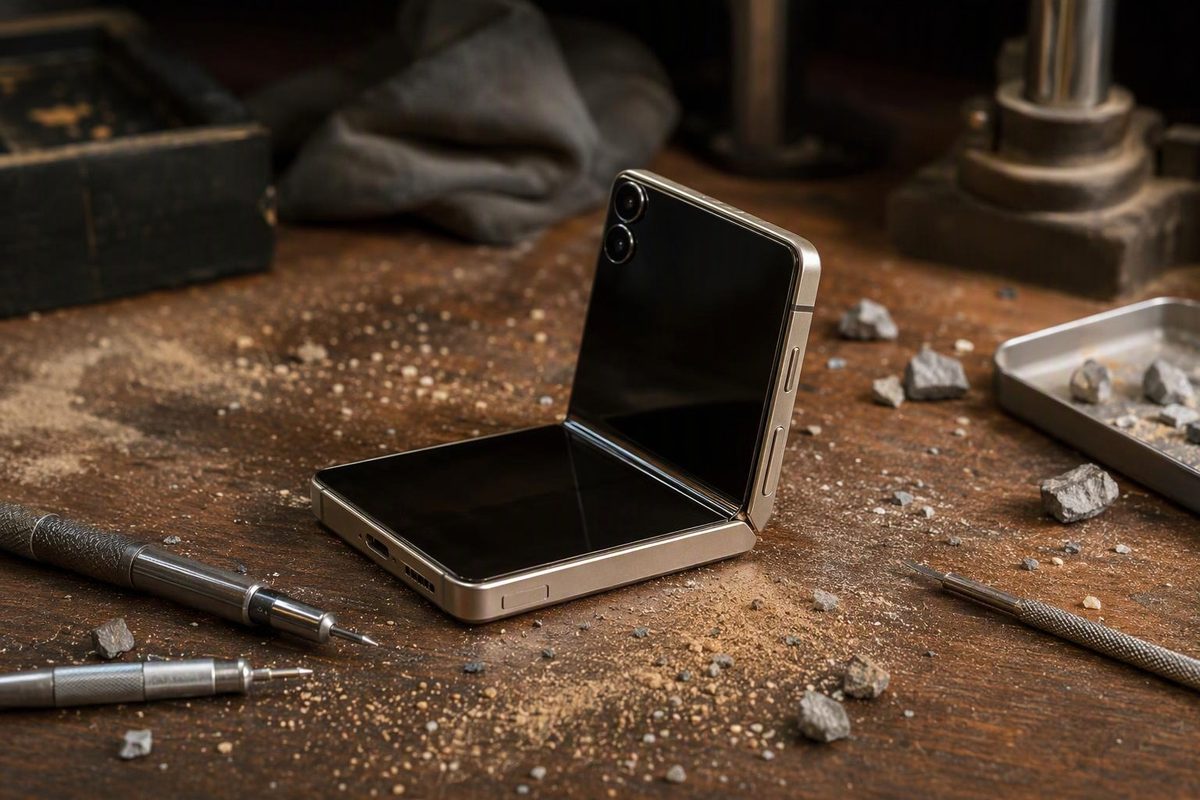
iPhone Duo’s titanium frame and IP68 rating have limits. Early tests separate repeated folding from inner-screen scratches, grit and hinge impacts.
iPhone Duo has substantial durability engineering, but the early evidence does not justify treating it as a proven rugged phone. Repeated folding has produced an encouraging result; scratches, debris and impacts to the hinge have exposed different weaknesses.
As of October 27, 2026, this is a launch-week assessment, not a verdict on years of ownership. Apple announced availability beginning October 23, so long-term reliability remains unsettled. Apple’s launch announcement
What Apple’s durability claim actually covers
Apple’s strongest case is more specific than “it’s titanium.” The company describes a Grade 5 titanium frame and hinge cover, structural support ribs, and a hinge with more than 100 components that supports the display’s center. Within the folding screen, custom adhesives let layers slide past one another to relieve bending stress. Those mechanisms address stiffness and repeated movement—not just appearance. Apple’s design description
But three protections need separating:
- Exterior protection: Ceramic Shield 2 covers the front; Ceramic Shield protects the back.
- Inner-screen protection: A scratch-resistant coating and a nano-textured polymer cover layer protect the surface, with glass layers deeper in the display stack.
- Ingress protection: Apple specifies IP68 under IEC 60529, including immersion to a maximum depth of six meters for up to 30 minutes.
These are Apple’s material claims and published specifications, not independent proof of overall toughness. In particular, the exterior Ceramic Shield claim does not describe the surface you touch on the folding inner screen. Apple says nano-texture reduces glare; that benefit should not be mistaken for scratch immunity.
Early tests answer different questions
The independent demonstrations below are described through published reporting, rather than firsthand testing by this publication. They reveal possible strengths and failure modes, not an ordinary-use failure rate.
Folding endurance is the encouraging part
According to iPhone in Canada’s account of Joanna Stern’s test, a machine opened the cased phone to about 130 degrees and closed it 17 times a minute over four eight-hour nights. That totals 32,640 cycles. A before-and-after force measurement found the hinge slightly stiffer, with no noticeable deterioration in use. The report says Stern undertook the test because Apple had not published a fold-cycle rating.
The angle matters: this was not 32,640 full, flat openings. Nor can four nights reproduce years of aging, contamination and accidental impacts. It is nevertheless encouraging evidence that repeated folding did not quickly wear out the tested hinge.
Scratch resistance is not the same on both screens
Dexerto’s report on JerryRigEverything’s test describes faint exterior-screen scratches at Mohs level 7, versus inner-screen scratches at level 2 and deeper fingernail marks. The matte finish made blemishes less visible with the screen on; it did not remove them.
The same test left the hinge unable to close completely after debris exposure. Subsequent bending damaged the inner display until it became unresponsive. The reporting explicitly leaves open whether trapped debris contributed to the bend failure. That sequence cannot cleanly isolate the cause—or establish that every Duo will fail in everyday use.
A strong frame can survive while the display fails
PhoneBuff’s test, reported by iPhone in Canada, offers a mixed picture. The titanium frame sustained mostly cosmetic damage in a corner drop, and the open inner screen survived a face-down drop. The outer glass, however, cracked in a one-meter face drop.
Repeated drops of the closed phone onto its hinge from just under 1.5 meters then caused increasing opening resistance, display damage and eventually major inner-screen failure. Those hinge drops followed earlier drops on the same device, so this was cumulative abuse, not a fresh-device test of hinge impacts alone. The report also notes the sample size of one.
Closing the phone therefore does not eliminate every risk to the inner display: an impact can reach it through the structure. Conversely, one successful screen-first landing does not make that screen drop-proof.
IP68 is useful, but it is not an all-purpose durability promise
IEC 60529 classifies enclosure protection against access to hazardous parts, solid-object ingress and water—not overall resistance to drops or bending. NEMA’s published adoption of the standard
Apple also says resistance is not permanent, may decrease with normal wear, and was tested under controlled laboratory conditions. It warns against charging a wet iPhone and says liquid damage is not covered under warranty. Apple’s resistance footnote
The reported debris failure deserves attention, but it is not enough to declare the IP68 rating false: the coverage does not establish an equivalent standards-compliant test.
Should durability stop you buying it?
If your priority is low-maintenance toughness—especially around sand, workshop grit or frequent drops—the current evidence favors caution. Do not buy Duo on titanium and IP68 alone. Check local inner-display repair costs and accidental-damage coverage before deciding what risk you can afford.
If the folding display solves a real problem for you, the hinge-endurance result is a reason not to dismiss it outright. Our screen-size comparison can help judge that benefit. As precautions, keep hard objects away from the inner screen, avoid pressure on the unfolded phone, and consider a compatible protective case without assuming it makes the hinge impact-proof.
The defensible verdict: promising folding endurance, distinct surface and impact vulnerabilities, and no established long-term reliability record yet.