iPhone Duo vs iPhone 18 Pro: What the Screen Sizes Mean
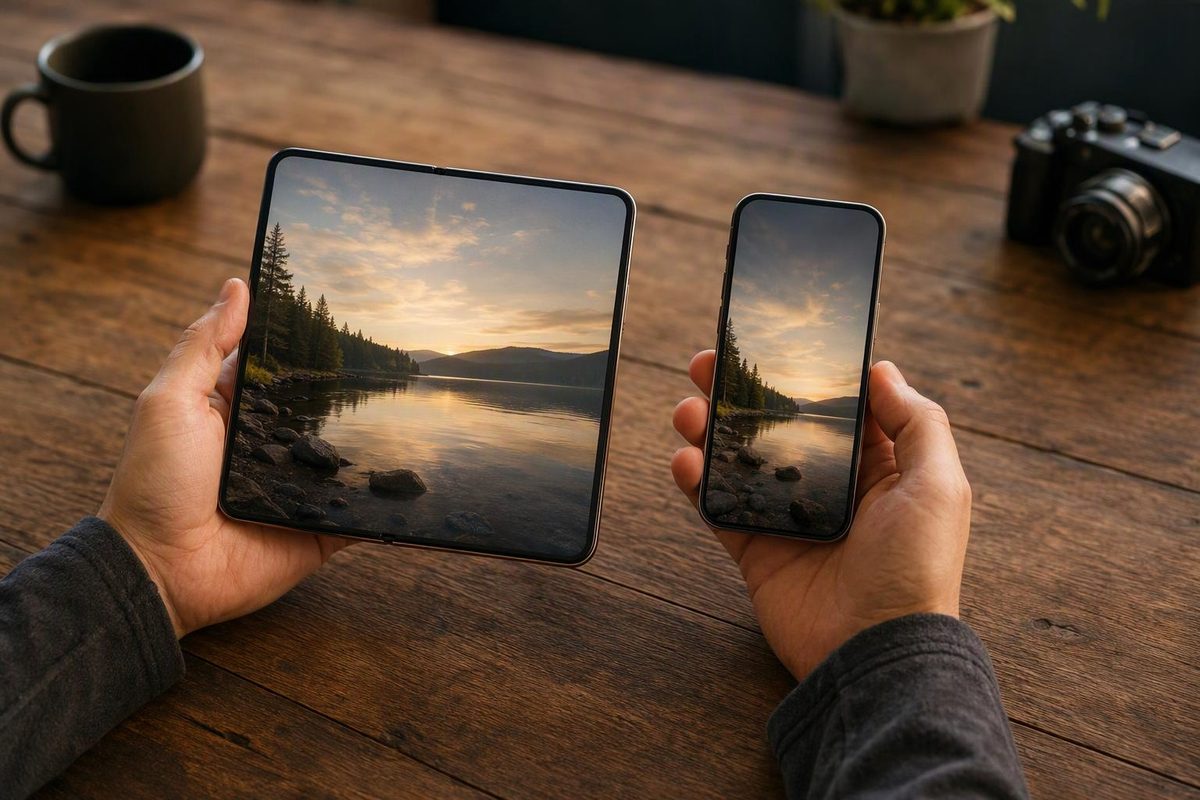
Duo’s 5.4-inch outer screen has about 90% of the Pro’s area. Its 7.6-inch inner screen is much larger—but usable space depends on the task.
iPhone Duo has a 5.4-inch outer screen and a 7.6-inch folding inner screen; iPhone 18 Pro has a 6.3-inch screen. Closed, Duo offers about 90% of the Pro’s screen area. Open, its inner screen has roughly 81% more rectangular area than the Pro, calculated from Apple’s specifications—not merely the 21% increase suggested by comparing diagonals. Duo specifications · Pro specifications
The important distinction: Apple’s advertised “50 percent larger” inner display compares Duo with iPhone 18 Pro Max, not the smaller Pro. Apple’s product page
The screen sizes side by side
These are Apple’s published display specifications. The area column is calculated, not a measurement of usable app space.
| Display | Advertised diagonal | Resolution | Approximate rectangular area |
|---|---|---|---|
| iPhone Duo, outer | 5.4 inches | 1398 × 2034 | 13.4 square inches |
| iPhone Duo, inner | 7.6 inches | 1878 × 2670 | 27.1 square inches |
| iPhone 18 Pro | 6.3 inches | 1206 × 2622 | 14.9 square inches |
| iPhone 18 Pro Max | 6.9 inches | 1320 × 2868 | 17.9 square inches |
Sources: Apple’s Duo specifications and 18 Pro/Pro Max specifications.
The calculation is pixel width × pixel height ÷ pixels-per-inch². Apple lists 430 ppi for Duo’s inner display and 460 ppi for the other three screens. These published figures have limited precision, so the results are approximate. Rounded corners and interface elements further reduce usable space; Apple explicitly notes that Duo’s actual viewable area is smaller than its enclosing rectangle. Apple’s announcement, display footnote
On that basis:
- Duo closed versus Pro: about 10% less area.
- Duo open versus Pro: about 81% more area.
- Duo open versus Pro Max: about 52% more area, broadly consistent with Apple’s 50% claim.
Why the smaller outer diagonal is misleading
A diagonal measures corner-to-corner distance, not area or grip width. A shorter, wider rectangle can retain much of a taller screen’s area despite having a smaller diagonal.
Using Apple’s resolution and density figures, Duo’s outer display is approximately 3.04 inches wide by 4.42 inches tall, compared with 2.62 by 5.70 inches for the Pro’s display in portrait orientation. Those are calculated screen dimensions, not handset dimensions. Duo specifications · Pro specifications
So “5.4 inches” should not be read as “a narrower version of the Pro.” If thumb reach is your concern, check the folded handset’s width and how you hold it—not just its screen diagonal.
What the extra inner area actually buys
Two apps at once: Apple documents Split View with two apps side by side. An ideal equal division of the inner screen would give each app about 13.6 square inches before controls and the divider—roughly 91% of a Pro screen’s rectangular area. That is useful room for referencing a page while writing, but it is not two full Pro displays, and each pane has a different shape. Apple’s multitasking description
Reading and browsing: The broader canvas can accommodate wider layouts or larger text. Whether it shows more information depends on the app’s layout, text settings and keyboard—not area alone. Apple says its apps are optimized for Duo and provides APIs for third-party developers to adapt theirs. That is a vendor claim about software support, not proof that every app uses the space equally well. Apple’s announcement
Movies: A wider-than-screen video needs letterboxing to preserve the whole picture, or cropping to fill the display. The increase in total panel area therefore does not translate directly into the same percentage increase in movie picture size.
If you mainly use one app while the phone is closed, compare Duo’s outer screen with the Pro in person. If you regularly need a reference beside another app, the inner screen and Split View are the meaningful upgrade. The useful question is how often you will unfold it—and what your apps do with that space.