A Faraday Pouch Protects Your Key Fob—not the Whole Car
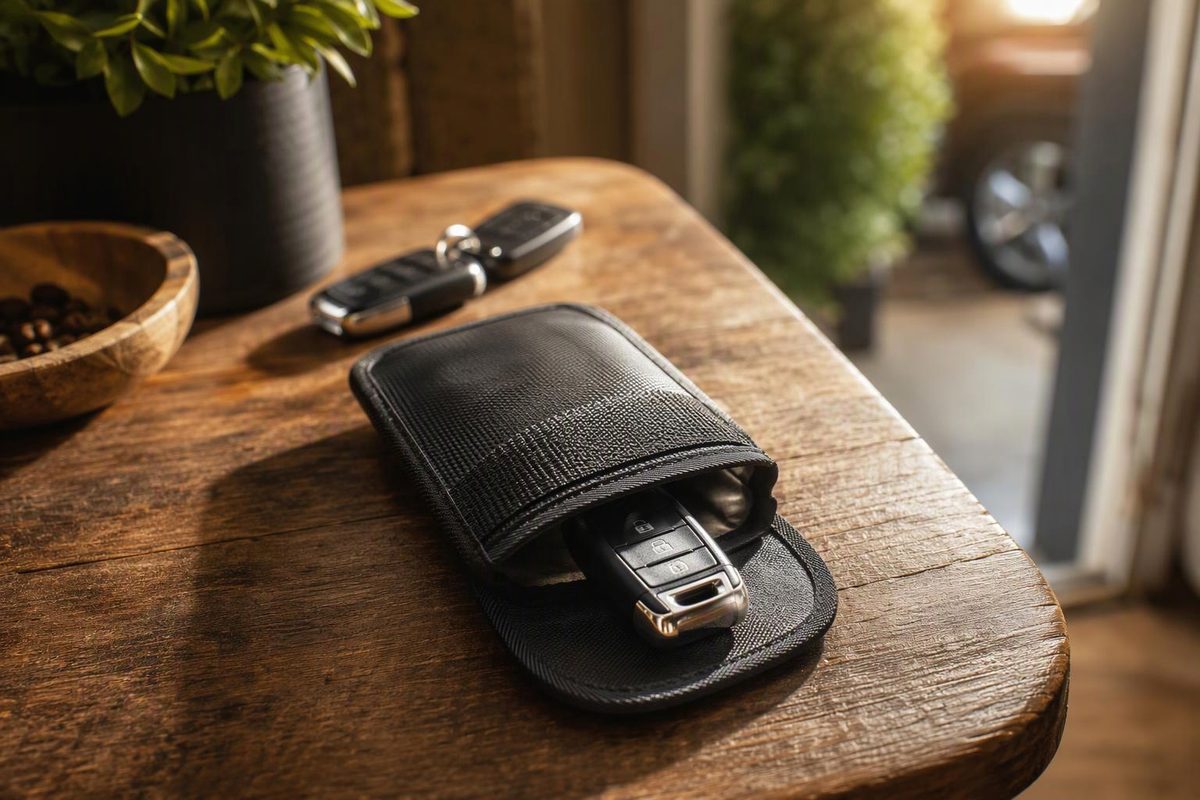
Faraday pouches can block keyless relay theft. Learn how to test yours, protect spare fobs, and understand what sleeping keys and UWB change.
A working Faraday pouch can stop a relay attack by preventing your car and its key fob from communicating while the fob is enclosed. That is a useful protection—not a guarantee that the car cannot be stolen.
The important distinction is blocking one route to theft versus securing the whole vehicle. For an owner with a vulnerable passive-entry system, a pouch is a practical precaution, provided it works with the actual fob, is closed correctly and protects the spare keys too.
What the pouch interrupts
Passive keyless entry lets you unlock a car without pressing a button on the fob. On vehicles with passive start, you can also start it while the fob remains in your pocket or bag.
A relay attack extends the radio conversation between the car and the genuine key. Equipment near the car and equipment near the key make the car behave as though the key is nearby, even when it is inside your home. The attacker does not necessarily copy the key or defeat its encryption: the real key supplies a valid response over the relayed connection.
That distinction comes from ETH Zurich researchers’ original relay-attack study, presented at NDSS in 2011. They demonstrated attacks on the systems they tested despite authentication and encryption. The study explains the mechanism; it is not evidence that every car sold today is vulnerable.
A Faraday pouch uses conductive shielding to interrupt that communication. Warwickshire Police recommends signal-blocking pouches, but also tells owners to test them rather than assume they work.
If your car only unlocks when you press the remote’s button, that is not the passive-entry feature described here. Check the manual for entry and start separately; the presence of a fob or a start button is not a complete description of the security system.
Buy something you can verify
Look for a pouch intended for car key fobs, with enough room to close fully around your key and anything attached to it. A closure you will reliably use matters more than an impressive product name.
An “RFID-blocking” label alone is not proof of compatibility. The ETH study describes key systems using different radio-frequency channels; blocking one application does not establish that a sleeve blocks the channels your fob uses.
Prioritise:
- Full enclosure: the fob must fit without preventing the specified fold or seal.
- Clear instructions: if the pouch has multiple compartments, identify which one is shielded.
- Durable construction: inspect the lining and closure for damage as it ages.
- A return option: you need to check the product with your own key and car.
RACV’s guidance likewise stresses correct sealing, fit, construction and regular testing because shielding can become ineffective with wear. A metal tin may work too, but police guidance says to test it before relying on it. Metal-looking packaging is not a test result.
Test the pouch with your car
The basic police-recommended check is simple: enclose the key, approach the car and see whether it unlocks. The following steps add controls to make that check more meaningful:
- Remove other authorisation sources. Keep spare fobs—and any enabled phone-based digital key—from authorising the car during the check.
- Establish a baseline. With the test fob outside the pouch, confirm that passive unlocking works. This avoids mistaking an already-sleeping fob for successful shielding.
- Lock the car again. Put the fob in the shielded compartment and close the pouch exactly as instructed.
- Try passive entry. Approach the car and use its normal handle or proximity-unlock action. It should stay locked.
- Check the control again. Remove the fob and confirm normal operation returns.
If the car opens with the fob enclosed, do not rely on that setup. Check the compartment and closure, then retest or replace the pouch.
Repeat the check periodically and after visible damage. Protect every working fob, including spares—not just the one you carry. This home check demonstrates that normal passive entry was blocked under those conditions; it is not laboratory certification against every possible relay device.
Sleeping keys and UWB change the picture
Some fobs stop responding after they have been stationary for a while. That helps during storage, but leaves a window before sleep and restores operation when the key moves. ADAC identifies that delay as a limitation of motion-sensor keys.
Other systems use ultra-wideband, or UWB, to measure the key’s distance through signal travel time. ADAC reports that vehicles using this protection resisted the radio-extension equipment in its tests. That is stronger evidence than simply having a “smart key,” but it is still evidence about a particular attack—not immunity from theft.
Ask the manufacturer or dealer about your exact model year and fitted system: can passive entry or the fob be disabled, are security updates available, and does the vehicle have motion-sensor or distance-measuring protection? Thatcham Research recommends checking for deactivation options and available security enhancements.
What remains exposed
A pouch cannot stop an attacker who bypasses the key altogether. In a 2023 investigation of CAN-injection theft, automotive security researchers Ian Tabor and Ken Tindell examined a device that injected false messages into a vehicle’s internal network. The genuine fob was not needed. Shielding it would not address that route.
Nor does a pouch secure a stolen physical key or prevent forced entry. Keep keys away from doors and windows, verify that the car is locked, and consider a separate physical deterrent such as a steering-wheel lock. Thatcham’s security guidance recommends checking locks and using physical deterrents.
For a vulnerable passive-entry car, a tested pouch is worth using. Its job is specific: keep the genuine key unavailable to a radio relay while you are not using it. The rest of the car still needs protection.